Wilkie's syndrome: a case of duodenal occlusion by aortomesenteric clamp
DOI:
https://doi.org/10.35954/SM2017.36.1.6Keywords:
Superior Mesenteric Artery Syndrome; Wilkie SyndromeAbstract
Wilkie´s syndrome or Superior Mesenteric Artery Syndrome, is the duodenal obstruction at its third portion,
due to the narrowing of the aorto-mesenteric clamp angle. It usually evolves progressively with chronic
elements and a great gastro-duodenal distention.
Clinical characteristics are: colic-type pain on the upper abdomen area which improves with profuse and biliary vomiting.
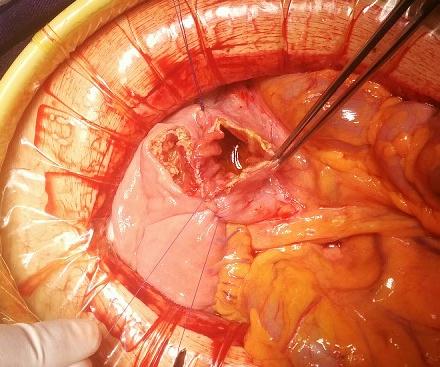
Report of a Superior Mesenteric Artery Syndrome case, diagnosed and surgically solved in our Service.
Patient with elements of a duodenal stenosis, with a diagnosis of Wilkie´s syndrome and surgical treatment
through the duodenal-jejune bypass, achieving good results.
Downloads
References
(1) Etxebarria Beitia E, Díez del Val I, Loureiro González C, González Serrano C, Bilbao Axpe JE. Duodeno yeyunostomía laparoscópica como tratamiento del síndrome de la arteria mesentérica superior. Cir Esp 2014; 92(2):129-31.
(2) Rodríguez Caraballo L, Carazo Palacios ME, Ibáñez Pradas V, Rodríguez Iglesias P. Síndrome de Wilkie: diagnóstico diferencial de dolor abdominal. An Pediatr (Barc) 2015; 82(6):445-46.
(3) Rodriguez A, Romero Vidomlansky S, Ferrarotti C, Larrañaga N, Gallo JC, Kozima S. Síndrome de la arteria mesentérica superior. Presentación de un caso. Rev Argent Radiol 2014; 78(2):96-98.
(4) Lundell L, Thulin A. Wilkie's syndrome-a rarity? Br J Surg 1980; 67(8):604-06.
(5) Núñez Gaviño P, Vázquez Ferro D, Bazarra Carou R, Deza Garrote T. Síndrome de la arteria mesentérica superior o síndrome de Wilkie. FMC 2013; 20(2):114-5.
(6) Jo JB, Song Y, Park CH. Laparoscopic duodenoje-junostomy for superior mesenteric arterys yndrome: report of a case. Surg Laparosc Endosc Percutan Tech 2008; 18(2):213-215.
(7) Kurklinsky A, Rooke T. Nutcracker phenomenon and nutcracker syndrome. Mayo Clin Proc 2010; 85(6):552-59.
(8)GustafssonL,FalkA,LukesPJ,GamklouR. Diagnosis and treatment of superior mesenteric artery síndrome. Br J Surg 1984; 71(7):499-501.
(9) Kellog E, Kellog W. Chronic duodenal obstruction with duodenojejunostomy as a method of treatment. Report of forty-one operations. Ann Surg 1921; 73(5):578-608.
Published
How to Cite
Issue
Section
License
Until 2024 we use the Creative Commons Attribution/NonCommercial Attribution 4.0 International License https://creativecommons.org/licenses/by-nc/4.0/deed.es. Which states that: you are free to share, copy and redistribute the material in any medium or format, as well as to adapt, remix, transform and build upon the material. Under the following terms:
Attribution: you must give proper credit , provide a link to the license, and indicate if changes have been made . You may do so in any reasonable manner, but not in such a way as to suggest that you or your use is endorsed by the licensor.
NonCommercial: you may not use the material for commercial purposes.
As of 2025 authors retain their copyright and assign to the journal the right of first publication of their work, which shall simultaneously be subject to the license https://creativecommons.org/licenses/by-nc-sa/4.0/deed.es that permits sharing, copying and redistribution of the material in any medium or format provided that initial publication in this journal is indicated. Adapt, remix, transform and build upon the material. If you remix, transform, or build from the material, you must distribute your contribution under the same license as the original and may not make use of the material for commercial purposes.
Under the following terms:
1. Attribution: you must give proper credit, provide a link to the license, and indicate whether changes have been made. You may do so in any reasonable manner, but not in such a way as to suggest that you or your use is endorsed by the licensor.
2. NonCommercial: you may not use the material for commercial purposes.
3. ShareAlike: if you remix, transform or build upon the material, you must distribute your contribution under the same license as the original.




PlumX Metrics