Basic course on chemical weapons protection.
DOI:
https://doi.org/10.35954/SM2012.31.1.10Keywords:
Chemical Agents; Chemical Weapons; Chemical Compounds.Abstract
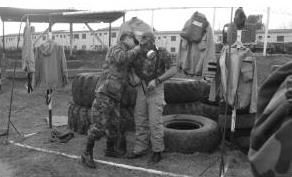
Between May 7 and 11 of this year, the Basic Course on Protection against Chemical Weapons was held at the Combat Engineer Battalion No. 6. This military unit has a Q.B.R.N. (Chemical, Biological, Radiological and Nuclear) Squadron, which received formal assistance from the Organization for the Prohibition of Chemical Weapons (OPCW).
which received formal assistance from the Organization for the Prohibition of Chemical Weapons (O.P.A.Q.) during the period 2005-2007.
The objective of the course was to provide theoretical and practical training on the types and effects of Schedule 1 chemicals (O.P.A.Q. classification for substances (or precursors) that have been developed, produced, stockpiled or used as chemical weapons and substances that have little or no usefulness for purposes not prohibited by the Convention) and industrial toxins, personal protective equipment, recognition and detection of contaminated areas, decontamination procedures and first aid for patients affected by these chemical agents.
As a final evaluation exercise, a road accident involving a vehicle transporting unauthorized chemical products was simulated, with an explosion and spill. The students of the above-mentioned course and the ensigns of the Armed Forces Health School participated in the exercise.
With the completion of this Basic course on protection against chemical weapons, conditions were created for the future implementation of the Advanced Course and the Specialist Course, which would complete the levels required by the O.P.A.Q. in this area.
Received for review: June 2012.
Accepted for publication: August 2012.
Downloads
Metrics
Published
How to Cite
Issue
Section
License
Until 2024 we use the Creative Commons Attribution/NonCommercial Attribution 4.0 International License https://creativecommons.org/licenses/by-nc/4.0/deed.es. Which states that: you are free to share, copy and redistribute the material in any medium or format, as well as to adapt, remix, transform and build upon the material. Under the following terms:
Attribution: you must give proper credit , provide a link to the license, and indicate if changes have been made . You may do so in any reasonable manner, but not in such a way as to suggest that you or your use is endorsed by the licensor.
NonCommercial: you may not use the material for commercial purposes.
As of 2025 authors retain their copyright and assign to the journal the right of first publication of their work, which shall simultaneously be subject to the license https://creativecommons.org/licenses/by-nc-sa/4.0/deed.es that permits sharing, copying and redistribution of the material in any medium or format provided that initial publication in this journal is indicated. Adapt, remix, transform and build upon the material. If you remix, transform, or build from the material, you must distribute your contribution under the same license as the original and may not make use of the material for commercial purposes.
Under the following terms:
1. Attribution: you must give proper credit, provide a link to the license, and indicate whether changes have been made. You may do so in any reasonable manner, but not in such a way as to suggest that you or your use is endorsed by the licensor.
2. NonCommercial: you may not use the material for commercial purposes.
3. ShareAlike: if you remix, transform or build upon the material, you must distribute your contribution under the same license as the original.




PlumX Metrics







 /
/