Use of anti-infectives in H.C.FF.AA. rooms.
DOI:
https://doi.org/10.35954/SM2001.23.1.2Keywords:
Anti-infectives; Defined Daily Dose; Drug utilization.Abstract
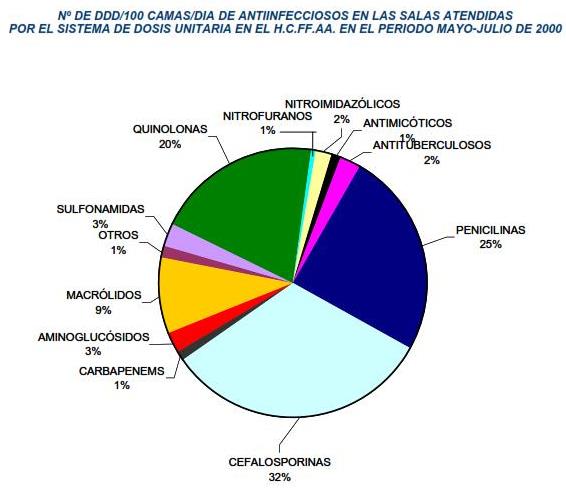
Drug utilization studies are a useful strategy to improve the quality of prescribing as well as to achieve rationalization of drug use. This paper presents the results obtained in a study on the use of anti-infectives in the inpatient wards of the H.C.FF.AA., which used the system of dispensing drugs by Unit Dose during the period May - July 2000. The technical unit of measurement used was the number of defined daily doses/100 beds/day, defining 12 groups of anti-infectives and grouping the wards into 8 different specialties. The total consumption of anti-infectives was 51.49 DDD/100 beds/day, the groups with the highest consumption being cephalosporins, penicillins and quinolones. In relation to the beds attended, the highest consumption was in the Infectious Diseases, Surgery and Traumatology wards.
Downloads
Metrics
References
(1) ESTEVEZ F. Uso racional del medicamento en las entidades médicas del interior. Bol. Federación Médica del Interior. 1996; Año 6 Nº 7: 9.
(2) RUIZ ALVAREZ I. Utilización racional de medicamentos. Facultad de Química Curso de educación permanente. 1995.
(3) Organización Panamericana de Salud, Oficina Sanitaria Panamericana, Oficina Regional de OMS. Métodos de Farmacología Clínica. 1992.
(4) ESCRIVÁ MUÑOZ J. CERCÓS LLETÍ AC. Farmacoeconomía: estudio de la eficacia en profilaxis antibiótica en cirugía Análisis de costes. Rev. O.F.I.L. 1993; 3(2):130-136.
(5) DAVIES DM. Los medicamentos y las infecciones. Adverse Drug Reaction Bulletin. 1995; 170.
(6) LOPEZ CABEZAS MC, HOMS PEIPOCH E, VITALES FERRERO MT. Análisis sistemático de la utilización de antibióticos como estrategia útil para mejorar la calidad de la prescripción. Farm. Hosp. 1999; 23(90):9101-9106.
(7) COBOS GARCÍA M, CAMEÁN FERNÁNDEZ B, SANTOS RAMOS FJ, BAUTISTA PALOMA MJ, TARÍN REMOHÍ N, MUÑOZ MUÑOZ R, et al. Utilización de antimicrobianos en hospitales públicos de Andalucía:1995-1996. Farm. Hosp. 1997; 21(5):272-282.
(8) Sociedad Española de Farmacia Hospitalaria. Estudio de utilización de medicamentos. SEFH. 1999; 23(87):11-15.
(9) Sociedad Española de farmacia Hospitalaria. DDD’s: Resultados del año 1998. SEFH. 2000; 24 (91):21-29.
(10) JANKNEGT R, OUDE LASHOF A, GOULD IM, VAN DER MEER JW. Antibiotic use in Ducht hospitals 1991-1996. J Antimicrob Chemother. 2000; 45(2):251-256.
(11) KIIVET RA, DAHL ML, LLERENA A, MAIMETS M, WETTERMARK B, BERECZ R. Antibiotic use in 3 European university hospitals. Scand J Infect Dis. 1998; 30(3):277-280.
Published
How to Cite
Issue
Section
License
Until 2024 we use the Creative Commons Attribution/NonCommercial Attribution 4.0 International License https://creativecommons.org/licenses/by-nc/4.0/deed.es. Which states that: you are free to share, copy and redistribute the material in any medium or format, as well as to adapt, remix, transform and build upon the material. Under the following terms:
Attribution: you must give proper credit , provide a link to the license, and indicate if changes have been made . You may do so in any reasonable manner, but not in such a way as to suggest that you or your use is endorsed by the licensor.
NonCommercial: you may not use the material for commercial purposes.
As of 2025 authors retain their copyright and assign to the journal the right of first publication of their work, which shall simultaneously be subject to the license https://creativecommons.org/licenses/by-nc-sa/4.0/deed.es that permits sharing, copying and redistribution of the material in any medium or format provided that initial publication in this journal is indicated. Adapt, remix, transform and build upon the material. If you remix, transform, or build from the material, you must distribute your contribution under the same license as the original and may not make use of the material for commercial purposes.
Under the following terms:
1. Attribution: you must give proper credit, provide a link to the license, and indicate whether changes have been made. You may do so in any reasonable manner, but not in such a way as to suggest that you or your use is endorsed by the licensor.
2. NonCommercial: you may not use the material for commercial purposes.
3. ShareAlike: if you remix, transform or build upon the material, you must distribute your contribution under the same license as the original.




PlumX Metrics








 /
/